

Smoother, Healthier-Looking SkinWith Prescription Copper Peptide
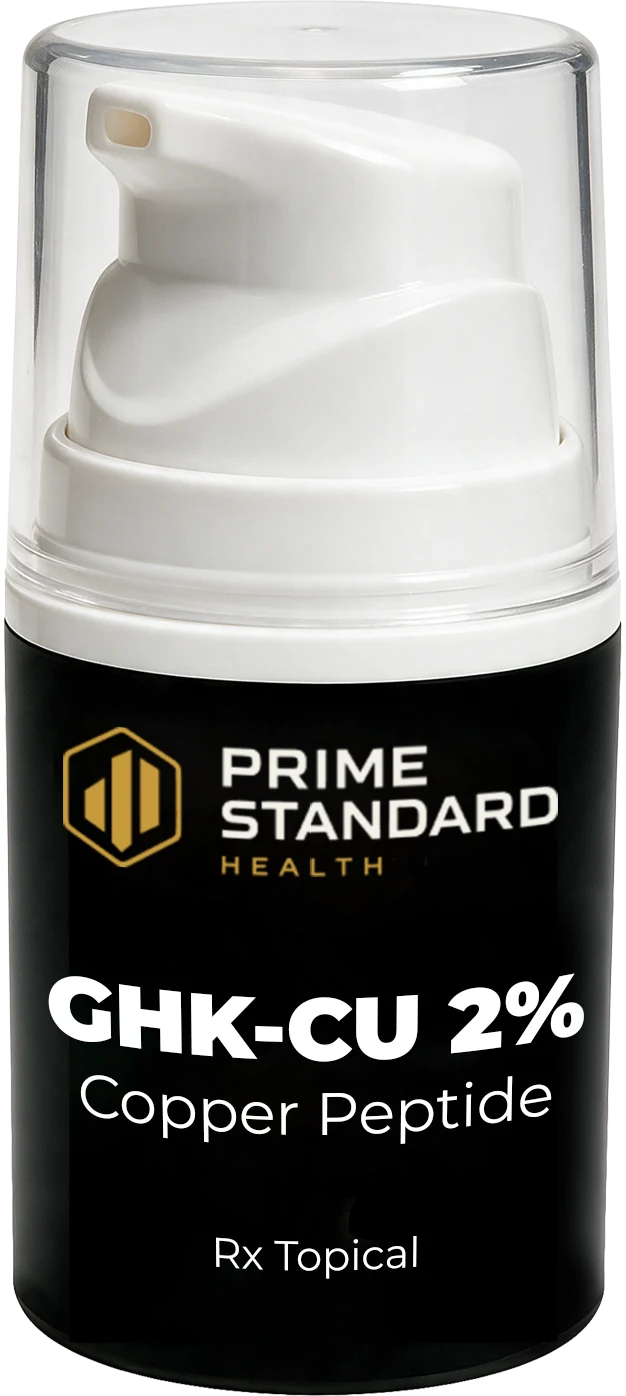
GHK-Cu is a copper peptide your body naturally makes on its own, and one of the most-studied molecules in skin science.
- Firmer, Smoother-Looking Skin
- Healthier, Refreshed-Looking Skin
- More Radiant-Looking Complexion
- Softer-Looking Fine Lines
What Is GHK-Cu?
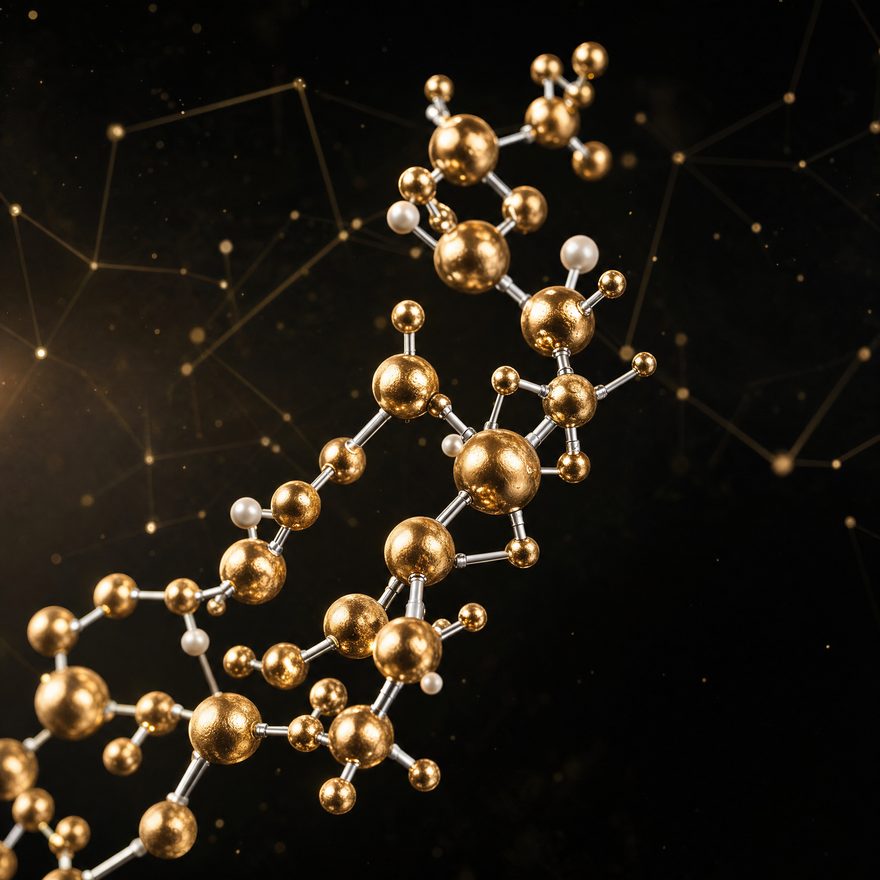
GHK-Cu is a copper peptide your body makes naturally — three amino acids bound to a copper ion. It's one of the most-studied molecules in skin science, most of that research concerning collagen.
As we age, collagen declines about 1% a year. That's when skin starts to look rougher, lines set in around the eyes and jaw, and the face in the mirror starts looking older than you feel.
How GHK-Cu Works
Your Body Already Makes It
GHK-Cu is a copper-binding tripeptide you produce on your own.
You Put It On
A topical you apply to clean skin, as directed by your doctor. No injections, no needles, no downtime, nothing to recover from.
Smoother, Healthier-Looking Skin
Firmer, smoother-looking skin. Softer-looking fine lines. A more radiant, refreshed-looking complexion — the kind of skin you'll be proud to have.
Benefits Of GHK-Cu
Firmer-Looking Skin

Smoother-Looking Texture

Reduce The Look Of Fine Lines

Healthier-Looking Skin

Radiant-Looking Complexion

Refreshed-Looking Skin
Backed By Research

Human skin fibroblasts, stripped of serum and every growth factor. GHK-Cu at one nanomolar. The cells divided faster and put out more of two growth factors.

Researchers used the Connectivity Map to search for compounds that would reverse the emphysema gene signature, and found GHK. At 10 nanomolar it changed how human fibroblasts handle type I collagen.

Skin collagen falls about 1% a year, every year of adult life. Measured across 148 adults, ages 15 to 93. Same rate in men and women.
You Lose 1% Of Your Skin's Collagen Every Year. By 50, A Quarter Of It Is Gone.
Collagen is the scaffolding under your skin. It decides how firm skin looks, how it sits, and how it catches light. The decline is steady, it starts in your twenties, and nothing about it is dramatic — which is exactly why it's easy to miss until you see a photo.
Skin collagen declines at roughly 1% per year through adult life; see Supporting Studies below. The line is drawn straight because the source reports the decline as linear. No datapoints are plotted and the axis carries no values. Individual levels vary and are not measured or diagnosed by this page.
- Your skin looks older than you feel.The face in photos stopped matching the way you actually feel. It shows around the eyes and jaw first.
- Your skin looks rough and dull.Texture goes before lines do. Skin that looked fine in any light now needs the right light.
- You look tired even when you're not.A late night or a hard week hangs on your face a few days longer than it used to.
- Drugstore serums haven't done anything.Most copper peptide serums are cosmetic-grade, under-dosed, and won't print a concentration.
What you put on your skin matters more than how hard you go at it. GHK-Cu has been in collagen research for fifty years — this is the prescription-strength version of it.

Transform How You Look With GHK-Cu
Proven Results. Pharmacy-Grade Quality.
Your GHK-Cu is compounded and dispensed by a state-licensed U.S. pharmacy operating under strict quality standards, with routine testing for potency and consistency.
The copper peptide market is full of cosmetic-grade serums with undisclosed concentrations. A prescription topical, compounded to a specified strength by a licensed pharmacy after a physician reviews your intake, is a different category of product — and the concentration is the whole point.
You'll also have ongoing access to your prescribing physician, so treatment can be monitored and adjusted as needed.
The GHK-Cu Process
Complete Medical Intake
Fill out a short medical intake so a licensed physician in your state can evaluate whether GHK-Cu is appropriate for you.
Physician Review
A state-licensed doctor reviews your information and determines eligibility. If approved, your prescription is issued directly through our pharmacy network.
Free, Discreet Delivery
Your topical is compounded and shipped directly to your door from a licensed U.S. pharmacy — free and discreet.
No insurance required. No in-person visits. Ongoing physician support included.
What GHK-Cu Is For
- Firmer-looking skin
- Smoother-looking texture
- Reduce The look of fine lines
- Healthier-looking skin
- Radiant-looking complexion
- Refreshed-looking skin
Prescription GHK-Cuvs. Over-The-Counter Serums
Here's the honest difference.
What You're Saving
In-clinic copper peptide treatments are priced per session. This isn't.
- 100% online medical evaluation — free
- GHK-Cu compounded by a licensed U.S. pharmacy — shipped free
- 24/7 support from your licensed doctor
- 2% (20 mg/g), 30 g airless pump every month
Prices published by U.S. clinics as of August 2026 and captured from each clinic's own published rates; the microneedling figure is for a face-only 60-minute session. A microneedling course and a daily topical are not the same treatment — this compares what the in-clinic route costs against what the at-home route costs, not what either one achieves. Prime Standard Health pricing shown is the per-month cost on the 6-month plan.
Your Questions, Answered Honestly.
What is GHK-Cu?
A copper peptide your body makes on its own — three amino acids bound to a copper ion. It's one of the most-studied molecules in skin science, with published work going back to the 1970s, most of that research concerning collagen and the network underneath the surface. What is well established is that skin collagen declines with age, at roughly 1% a year.
Start Free Online VisitWhat is GHK-Cu designed to support?
Skin appearance — firmer, smoother, healthier-looking skin. That is the whole lane. We don't prescribe or market it for hair, for wound healing, or for any skin disease or condition, and we don't offer it in any form other than topical.
Start Free Online VisitWho is it for?
Adults who take their skin about as seriously as their training, and who would rather have a physician and a compounding pharmacy involved than buy the serum of the month. If you're looking for something dramatic and fast, this isn't it.
Start Free Online VisitHow do I use it?
Your doctor sets the specifics — where you apply it and how often — as part of your prescription. It goes on clean skin. No needles, no downtime.
Start Free Online VisitHow long until I see something?
Skin changes gradually by nature and individual results vary. Your doctor will set expectations for your situation.
Start Free Online VisitWhat are the side effects?
Most people tolerate topical copper peptides well. The most common are mild application-site effects: redness, dryness or irritation, usually early on. Stop and contact your provider if irritation persists.
Start Free Online VisitWhere does my medication come from?
Your medication is compounded and dispensed by a licensed 503A compounding pharmacy in the United States and shipped directly to your door with free shipping.
Start Free Online VisitWhat if I'm not approved?
You're not charged unless a provider approves and prescribes treatment.
Start Free Online VisitHow does billing and shipping work?
Medication ships in discreet packaging with free delivery. Refills are automatic. Pause or cancel anytime.
Start Free Online VisitSupporting Studies
Every source below is linked in full, and reviews are labelled as reviews.
Primary human dermal fibroblasts taken from surgical patients, cultured without serum or growth factors, treated with GHK-Cu at 1 nM. Replication accelerated in both normal and damaged cells, and the damaged cells produced significantly more bFGF and VEGF. Stanford University Medical Center; published by the American Medical Association. The paper carries no funding or conflict-of-interest statement, which we note rather than omit.
A hypothesis-free screen at Boston University identified GHK without setting out to look for it, then confirmed it at the bench: 10 nM GHK reorganized the actin cytoskeleton of human fibroblasts, raised integrin-β1, and restored contraction and remodeling of type I collagen gels. The fibroblasts were lung-derived, not dermal — we cite this as connective-tissue evidence, not as a skin trial, because that is what it is.
States it directly: skin collagen "tends to decrease linearly by approximately 1% per year throughout the adult life, while the loss rate is the same across gender", across 72 men and 76 women aged 15 to 93. This is the source of the arithmetic in the section above. The underlying forearm measurements are Shuster S, Black MM, McVitie E, British Journal of Dermatology, 1975;93(6):639–643 — the 1%-per-year rate is Park's restatement of that dataset, not a figure printed in Shuster's own abstract.
These statements have not been evaluated by the Food and Drug Administration. This product is not intended to diagnose, treat, cure, or prevent any disease. If you are taking prescription medication, have a medical condition, or are pregnant or nursing, consult your physician before use. Not for children. Results may vary.
GHK-CU (copper peptide) is a naturally occurring peptide. GHK-Cu topical is a prescription medication prescribed by licensed healthcare providers when clinically appropriate. GHK-Cu is not intended to be prescribed by our physicians for the treatment of any skin disease or condition, for hair growth, or for wound healing. Compounded medications are not FDA-approved but are prepared by licensed pharmacies pursuant to a valid prescription. Individual results vary based on health status, dosage, and adherence.
New patients only · Limited availability